Showing posts with label #cynicism. Show all posts

04/08/2024

Collection Room

This short story was written in August 2020.

In the collection room, lit only by the light from a small window, over a thousand ugly sculptures cast their shadows. Figures are posed leering, scowling, and gesticulating. Individually, their awfulness is fascinating. Collectively, the room is a pandemonium, a carnival, a festival of hate. It belongs to my great aunt Bernadette, who is a witch. She knows she’s a witch, of course, but possesses the merest fragments of an idea of just how powerful she is.

Right now, Bernadette is on her way to collect me from the bus terminal. My parents have sent me to stay with her for a week or so, during the summer, to give them a break from my overbearing exuberance. She sits on the bus, handbag clutched to her chest. She likes to sit on the aisle side and put her shopping on the window seat, creating a small empire of her own, on the public bus.

The bus jerks around a corner and the bus terminal consumes the bus, becoming its external space. She gathers all her bags around her and forms the back legs of a queue centipede. Shortly, as she exits the bus, a young man in the uniform of the bus company pushes past her, speaking on his phone. She grimaces but alights mutely. Breath somewhat taken, she rests her bags on a deep window ledge in a nearby corner.

She feels the familiar weight in her pocket and, turning away from the human traffic, concealing her hands in the corner’s shadows, reaches in. It’s a tiny model of the uniformed man, his face arrogantly red, his oversized arms pushing, shoving. Later in the evening, she’ll put it in her collection room and an appropriately sized plinth or shelf will be there, waiting. She’s been doing this for years and nobody knows about it except her, so far.

She pushes the figurine back into her pocket and, as she turns, I catch sight of her.

“Great Aunt Bernadette,” I bellow, and hurry towards her, oddly lopsided as my legs haven’t quite recovered from the long bus journey.

“Hello, Joanne,” she enunciates perfectly. Her voice sounds soft though hoarse as she hasn’t used it for a while.

Believe it or not, that amounts to affectionate gushing coming from GAB. She’s not really a people person and hasn’t had a lot of kind words to say about anyone in my limb of the family. So, is it just me? I always got the impression that I was an odd but likeable girl, and seem, now, to have become an odd but likeable young woman, so maybe so, but the family is full of quirky, interesting and hospitable characters, and yet I’m the only one my great aunt would answer the phone to, never mind put up in her flat.

We make our way back to her abode, chatting pleasantly, until we get on the bus, which seems to bring the conversation to a determined hush. I notice that she spends a lot of time looking around, nervously, particularly as people get close, and they are not nice looks. She was always nervous about people, tending towards outright anthropophobia, but this is more extreme than I remember. Has the little satellite town of Flaxham gone to the dogs in the last few years? Well, perhaps there is a seething crime world behind the town’s art galleries and hatteries, but, if so, it’s far from apparent.

In due course, we enter her building and make our way up the stairs at an appropriate pace for mature ladies of unaskable ages. Somewhere between the third and fourth floors, a woman runs up the stairs, panting, talking loudly into her phone.

“Hang on, Jacob, honey, I’ll be there in a moment. Just keep squeezing the ball. I’ll be there soon, honey. Hold on!”

The woman’s hot worry blows past us, leaving behind the uncomfortable chill of Bernadette’s discontent.

“That’s really much too loud for the communal stairs,” she concludes.

“Alright, auntie, but it sounds like someone’s in trouble. If anything, we ought to go up and try to help!”

“You, perhaps, ought,” she is carving the words out of the air, her lips are so taut, “but I am sure it is none of my business.”

Preferring heated distress to the iciness of my great aunt’s words, I zip off after the concerned mother and try to lend a hand and, shortly, am dismissed with gratitude by the mother and her etiolated, but alive, son.

Later in Bernadette’s apartment, a punishingly small mound of couscous is served with a handful of steamed vegetables and a coin of lamb. It is a poor offering to my gargantuan appetite. I drink great volumes of water and try to distract myself with twenty year old editions of Reader’s Digest, occasionally glancing longingly down at the bakery on the street. Evening conversation is sliced between period dramas and Countdown and my ten days with Great Aunt Bernadette stretch before me as if over shimmering sand dunes, to a distant, beige horizon.

Later still, at night, the stomach rumbles have coalesced into a dull ache and although I belong in the hallway even less than I belong in the guest room, I decide to get up.

In the hallway, the electric fuzz of the dark gives way to the night-gowned form of Bernadette lingering, uncertain and ghost-like before a doorway I had not registered until that point.

“Are you okay, Auntie?”

She does not reply, and wonder if she is embarrassed, or still angry with me for trying to help her neighbour. Her actions are vague but I detect the linear glow of a key in moonlight, which she is raising to the door and then moving back to her side. She is mumbling an incessant muffled rant. My teenage work experience at the residential home has left its mark on me and I very gradually help her to lift her hand to the lock and insert the key. Once in, she wriggles it around in the lock until it gives with a faint reverberation.

She doesn’t go in. She turns back towards her bedroom, looking through me, and then, with a force that cannot logically have a point of origin in her unsteady physique, she strikes the door open with her right elbow and turns to face the room with unseeing eyes.

From behind her, my vision roams around the numerous, almost familiar characters in the room. It is a legion marching into reality from some other dimension. Glancing around at the array of sneering faces, lizard eyes, I am forced to conclude that whatever place gave rise to such an abhorrent parade must be foul indeed; a veritable hell.

“Auntie!” I gasp, and suddenly her eyes are on me, her expression somehow reminiscent of a mortified pug, and then I see it; a single glittering statue, a young woman with milk-smooth skin and strawberry hair, hands on hips and smiling from her glittering eyes to her pigeon toes. She’s beautiful and I wonder who she is.

Bernadette follows my gaze and gasps. I look closer and at the base is written ‘Joanne Marie Shepley’. It’s me. The single solitary statue amidst this Dantean free-for-all who looks remotely benevolent is of me. And as I watch, my avatar’s hand unfolds from her hip and points a judgemental finger, a frown forming on her earthenware brow.

“No, no, no, Auntie, no! I understand. I’m not against you. I want to help.”

She is conscient, now.

“You can’t help me. Nobody can.” I have never heard a voice so dejected, so lost, in all my twenty-two years on this Earth.

“I don’t believe you,” I tell her, and then notice something in her hand.

“What’s that?” I whisper in panic.

She lifts her hand towards me and opens it, fingers opening, her gaze focused on mine.

There are two more malevolent manikins in her hand; a uniformed arrogant figure and a mother-in-flight yelling into her mobile phone. She has already immortalised the woman who dashed past us a mere twelve hours ago. Not only that, but there are two small clearings on the plinth before us. The room is ready for them. I examine the plinth and find that this is the space for irritating neighbours, including the dark-skinned family next door, who are frightening and primitive to her. Well, her collection is well-curated, I’ll give her that.

I turn to suggest she place the new entries in their allocated place but she is gone. By the muffled bangs and clings, she is in the tool cupboard. I get as far as the door before she returns with a hammer in her hand and a look of grim determination.

“Let me past!” she shouts, and pushes me aside. Surprised by the sudden force, I stumble. She hefts the hammer and crushes a model of six demonic children into a mound of particles and then, again and again, she is smashing one after the other. Dozens upon dozens are rendered into dust before my eyes, to the sound of irregular percussion, and gradually heavier and more jagged breathing. I am relieved when she collapsed into a chair.

It is so sad to see her weep, the way she tries to wipe away the tears with the cuff of her pyjamas and misses, but what happens next is all the worse. The fragments of the statuettes begin to rise from their mounds. They are reforming! But now as the pieces of their faces bunch together, cracked and broken, they look all the more hideous. The pair of us look on in horror and despair. There will be no easy way to deal with this.

“You need to talk to them.”

“What? All of them?”

“Well, not all at once,” I say, gently.

She contemplates it.

“But I can’t. I don’t have long enough. I don’t know where they are!”

“You know where Mrs Henderson is,” I said, trying to stay calm.

“Who’s she?”

“Her,” I said, pointing to the figurine of the woman who rushed past us earlier, now jawless and with unsteady eyes.

“Not now!” she exclaimed.

I shrugged.

“In the morning, then.”

“But I’ll never find them all. I’m old and disgusting and nobody will help me,” she sobbed.

That is when I noticed a twitch behind a curtained off area at the back of the room. In the darkness, the main exhibit had remained unnoticed until now. The contents of this private booth were growing. Bernadette looked too struck with trepidation to move forwards, so I stepped towards it, but somehow she summoned the strength to get there before me.

“I think I know what’s behind here. I think I remember.”

She slid the curtain slowly back, the curtain’s metal rings grinding along their overhead runner.

It was disfigured, withered, and decrepit; its spiked fingernails were like talons, its arms reached out to throttle and yet it bore the expression of one shrinking away. It was like gothic horror’s reincarnation of a Dali woman, without the sensuality. If the discovery of myself in Bernadette’s collection had made my eyes pop out, it was a walk in the park with sandwiches compared to the discovery of Bernadette’s own twisted self-image.

“Yes, that’s exactly right. That’s what I am.”

“That’s not what I see, when I look at you.”

She gazed up at me.

“I’m very fond of you, Bernadette, and I’m so sorry you’ve got so lost.”

And then she fell into my arms and wept, with grating sobs that sounded like the last of the bath water going down the plug hole.

The rest of our holiday was extraordinary, if repetitive. We tracked down everyone we could identify and find, so Bernadette could have a chat with them. She invited them to coffee and asked about their children. When I saw her lose herself in a memory, her eyes angering, I would give her a nudge. Then, at the end of each day, we would unlock the Collection Room to marvel at how the statues were untwisting, ungnarling and, very slowly, starting to shine.

That one hideous statue at the back still looks pretty bad, but its features are softer and it doesn’t look so old. It’s an immense tragedy that my great aunt didn’t put her magic powers to good use earlier in life. Just think what she could have achieved. However, the tale goes to show that there’s always hope for the cynical old witches (and wizards) amongst us.

21/07/2024

The Thrill of the Case – Part Seven

Read Part Six of The Thrill of the Case, or go back to Part One.

"Based on the foregoing, your honour, I believe I have successfully proved that I, that is to say, Everarck Fanger, am not guilty of intellectual vanity."

And then because he'd always wanted to say it in a court.

"I rest my case."

And then he sat down, feeling immensely pleased with himself. This was the case that he'd painstakingly prepared with Gerellia, who'd turned out to be a vigorous advocate of his right to prove himself innocent of the ugly sin. He'd enjoyed working with her over the ten days or so of preparation, grown warm towards her, and privately in the comfort of his own mind, he was prepared to admit he'd even bonded with her more than a man in a long-term relationship ought to have.

He'd begun - and this had been his own idea - with a dictionary definition.

"Intellectual vanity can be defined - according to Cox and Moodie - as an excessive pride in one's own intellect or knowledge, often leading to a sense of superiority over others. Those who commit the sin of intellectual vanity often feel their own intellectual achievements or opinions are superior to those of others."

Gerellia had agreed that that provided a tidy opening to the subject. All he had to do now was go through the definition, bit by bit, and explain how no part of it described him, or his evident attitudes to others. She had even reminded him, "It doesn't matter if a defendant is actually guilty of a crime. It only matters if the defendant's conduct evinces criminal behaviour."

He had squirmed as she'd used words like 'crime' and 'criminal'. The other words: 'argument', 'demonstration', 'trial', 'judgement', with these he was comfortable, but 'punishment', 'prisoner' and 'sentence' made him shudder. Gerellia realised, watching him, that he saw the process as a high-minded exploration of whether certain qualities manifested in his behaviour. He had not, however, really grasped that he was in a literal court, which he had paid upwards of three thousand pounds to prosecute him and to which he had granted the power of finding him guilty of this form of behaviour, a social ugliness, which he himself had declared to be undesirable.

Intellectual vanity was not a crime, and the court had no power to imprison, but it was at the very least the architect of a public event whose proceedings had the power to stain a person's reputation, to humiliate them even as they attempted to wriggle free from the shadows in their own mind. Gerellia was not a lawyer. Everarck had simply assumed that. In fact, Gerellia was a psychologist, and what she saw in Everarck fascinated her. Never before had a person so obviously guilty of a social ill provided themselves to a process with such a powerful means of measuring it in them. That Everarck's motivation was to prove himself free of such vanity only plated the event with, to her, a profoundly satisfying irony.

She'd watched as Everarck had described his parents, his childhood, his dreams as a young person, his education and intellectual dreams. It had been a beautiful start to a strong argument. However, as the ten days progressed, shadows had swept over the self-examination, his gleaming autobiography. He had described his dreams of becoming a doctor which had seemed to wither even as he had pushed himself towards them. His daydreams of receiving that scroll of achievement had acquired, on one hand, the glow of utopian fantasy. On the other, parallel visions had showed the process as yellow and tawdry: the giving of a meaningless piece of paper in a dirty city hall surrounded by clowns in ridiculous gowns. Becoming tormented latterly that he would not be accepted by any university he'd want to join, he had pulled back from his exam preparation, and the results had been consequently mediocre.

"It was them!" he'd told Gerellia in strict confidence, "They were the intellectually vain!"

It was the gatekeepers of academic achievement who had been guilty of the sin. Gerellia had nodded encouragingly. From her own studies and the literature, she knew that accusing others of a sin is a behaviour repeated often amongst those most culpable of it. Then, taking pity, she had explained the phenomenon of projection to him, and got up and walked out of the room to allow him some time to himself. Clouds had occluded the sun that Tuesday afternoon, and the previously cheerful plant in the corner of the room had grown sullen.

He was guilty, he realised at last: guilty, guilty, guilty, guilty, and all that remained for him was to become a new man from this moment onward, to stand up in court and show that the events of the past no longer stuck to him. The best way to do that, the plant explained to him, was to plead guilty. Cleanse yourself, accept punishment, move forward, enjoy honesty.

"You smug bastard of a plant," he hissed, raising a pair of office scissors at it and stabbing the air, "I'll get out of this shit on my own if you won't help me!"

And then he had constructed his tale of Everarck the Innocent, knowing full well that it was a work of fiction, promising himself that he would not let himself off the hook in the court of his mind, if only he could evade the public humiliation now facing him.

12/07/2024

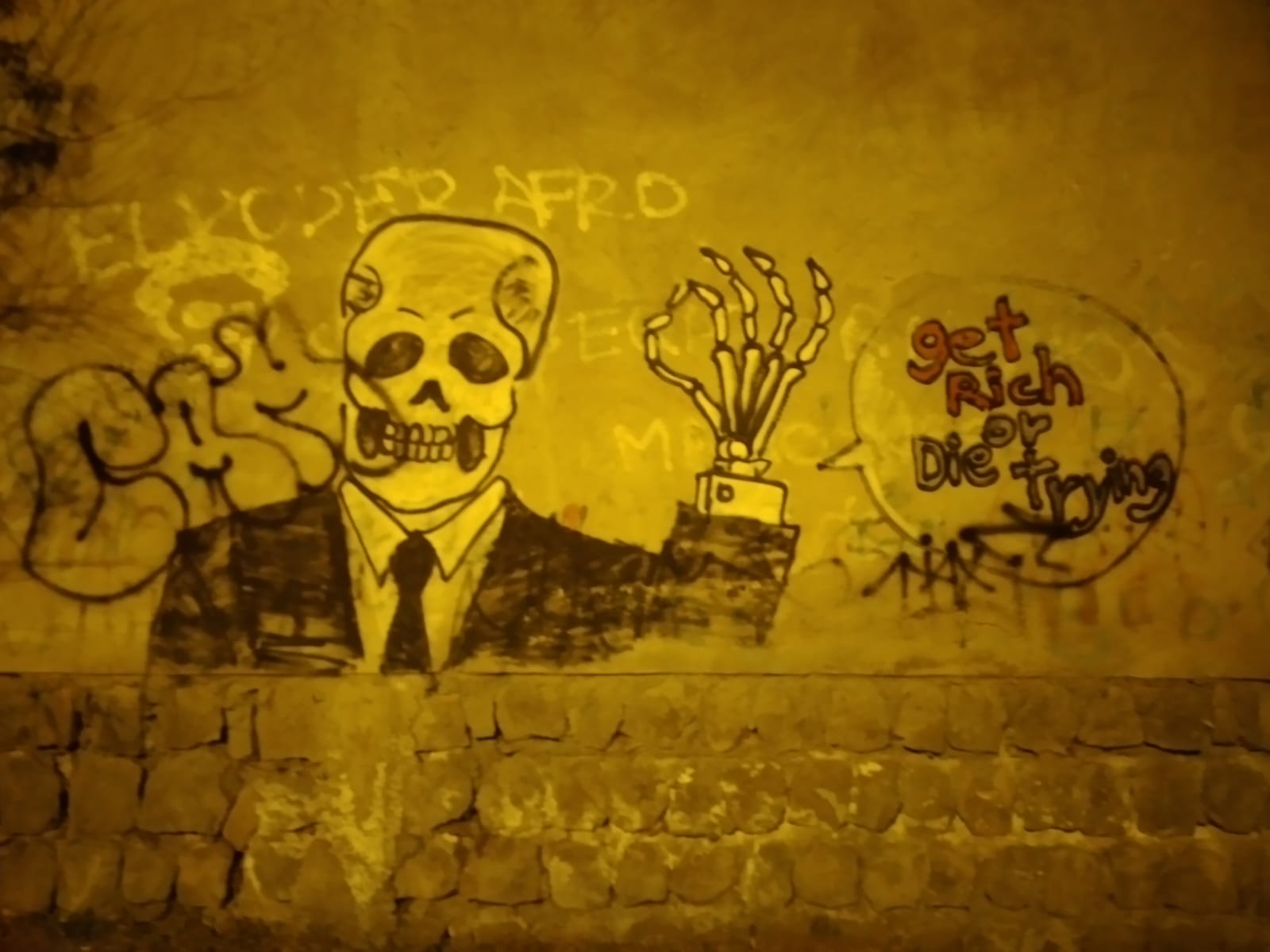
Get Rich or Die Trying!

Do you see him? The bloke in the cap and overalls. No, not him. Actually, that's a woman. But don't worry. Easy mistake to make. We all look the same down 'ere. No, the one with the empty wheelbarrow, lining up to go down the tunnel. Yeah, him. Bearded, red eyed. Yep. That's how it is. He's waiting for all this lot to come out. String of, what, eight, nine folks coming out with their barrows full of that grey-brown awful-smelling sludge. That one whose sludge is a quivering heap all the way up to his neck. That, ladies and gents, is today's gold star winner. He's gonna get one of the high-up boxes. He'll have to climb up there, mind, at the end of this bloody long shift that lasts every day from infancy till death.

Anyway, there I go. Tunnel's clear now. It's even darker in there than the rest of this place, but at least there's no buttons. You see, all those grey slabs that make up the walls. Sorta four metre square, regular as regiments, all the way up. You look up and your eye can follow the dark in-between lines all the way to heaven. In fact, they actually seem to converge at some point somewhere south of heaven, but you see how high up it goes. Or - more accurately - that's how far down we are. It could even have been a huge pyramid that we're in except that then no light would get down here and some does bounce all the way down here. Get stuck it does. The light goes into your brain and sticks there, becomes part of you, never gets out. Nothin' ever gets out of here, mass or wave form.

I'm out the tunnel now, see how I'm looking at the slabs. Each one's a button. Look carefully and you'll see that pale pattern on it is not just weatherin', it's a symbol. Press the right symbols in the right order, bingo, sludge time. Fill your barrow. Earn a few more points. Me, I always go with wavy lines, hash symbol, triangle, circle, inequality sign, plus, plus, upside-down exclamation mark. Found a few variations that worked, and a few that occasionally pumped out more sludge than I usually get, but this is the one that worked for me most consistently. There I am pushing in the huge square faces of the blocks, more 'n double my height. Some of them are really tight, hard to press in. You feel like you're actually liftin' the whole thing and forcin' it back. Don't tell me we're not strong, despite the revolting stuff they call food here.

Right, but once you've got it pushed in, as I have there, I don't know if they meant it like this, but then you can just about get your fingers and toes in the gap and climb up. How? You learn by falling. You learn by failing. That's the only way. Fall from a low height's my advice. Break a leg on your first day. You won't make it. Dunno what happens to them. They just lie on the dirty sludgy concrete floor screaming and then whimpering for the rest of the day. In the morning - gone. Must come in the night and drag 'em off, I suppose. F'r all I know, they use these same barrows to do it. Imagine. The same broken-wheeled thing I drag around, day after day, could be the same damn thing that drags me off when I'm all finished and done. Who knows what creatures does it either? Dunno if it's creepier to think there's some white-faced night creature to sweep up the human debris, or if it's folk like us what does it.

I'm the first in this section. Others are going past me down other tunnels to other spaces. I'm always glad when I don't have to go down there though. The piles of skulls and bones really get to you. Especially if you know who some of them were. Memento mori's one thing, but seeing yourself in that heap of bones offers no insight nor hope. So I have the space to myself except for those who's climbing up over my head to get at buttons they want on the third or fourth level. Climb like monkeys, they do. Having said so, the shoes they give us is just like a leather bag. Like ballet slippers. Wearin' boots'd be no good. How you supposed to climb in steel toe caps? Anyways, eventually I get all my buttons pressed in, and I feel the tremor before I hear it. "Pipe!" I shout to claim it and pretty much expertly get my barrow turned around probably less than a second before the flap opens on one of the terracotta pipes that stick out the wall, and glorious filthy muck fills my wheelbarrow up, piles right up, wobbling in that obscene way that it does. Nice! You can see that's a nice barrow! You can even see a grim look of satisfaction on my face if you look through all the shadow and hair.

Then I wheelie the thing around careful of folks in a rush coming the other way. We’ve all done it. You ready your barrow full of stinking muck thinking this could be the very one that opens a nice high hatch for you, and some wild barrower comes the other way not seeing anything and clang, there’s two barrows all over the floor and your muck is glugging and bubbling away down one of the little barred drains. Scoop it up with your hands. The one that knocked into you might even help if they don’t pull up their barrow and run off in shame and fear, but by the time you’ve scraped up as much as will stay in your hands, all the pleasure, all the satisfaction has gone, and you’re empty, and your barrow might as well be. However, this is not what the next moments have for me to live, and I’m able to get my barrow back through the tunnel to the tipping place, that great dark mouth in the corner guzzling up yards and yards of slime, just as we guzzle up whatever pathetic trickle it is that life has for us. And then I turn around, and I go back.

Course, I’m looking up to see if one of the huge buttons has come unlatched from the wall. Look at him. I mean me, of course. It’s just that, while I’m outside of myself, looking back, I see another man, so it’s him, even though it’s me. Anyway, you can see from my posture that I’ve been at this a long screed of time, more than eight hours, maybe nine. And I do this every day. I’ve been doing it every day for, well, I’ve counted eight full moons, put it that way. When the door comes unlatched, you scramble up the wall, like I said, toes and fingertips clamped into the tiny grooves between the buttons. None of these cracks would ever hold your full weight, so you have to keep moving. Each one is a pivot, and you can only use the toeholds and fingerholds by moving your weight around them and past them. It’s a real upward scuttle, and after nine, sometimes ten hours of barrowing, it’s a true wonder that any human body can do such a thing, but the final reward, a bed and a meal in a dark, quiet room and time enough to sleep; these are everything after a long shift.

Nothing yet, though, so I’ve to go on barrowing. I’d joke that it could drive you mad, but let me tell you a story about a fellow barrower, no name of course, but he bore the code of X-967-T on his overall, and I suppose that he had the same characters in tattoo because I do, and god knows there’s nothing to separate me from anyone else in this pit other than how much suffering I can take before I go the same way as that poor bastard. Well, X-967-T came to me, one day, early enough in my shift, and I think the beginning of his. His eyes were gold with excitement, and he was saying “This is it. I’m going to get rich. I had a dream. I had a dream. I know the code. Come and watch.” I said to him, “967, don’t do it. I know what you’ve dreamed, and I know what’s up there. Don’t go up there. Don’t go.” But he was already too far gone. Riches and success had filled the vacuum where his ruined soul used to be, so I put down my barrow and watched him scale the wall, hugging himself tight to it, and forcing in this button and that on his way up the wall, zig-zagging upwards between them. I saw his code started square, padlock, wheel, duck’s foot, at symbol, but I lost track after that due to the foreshortening of the higher buttons and weakness of memory. He was just going up and up, yelling, “I’m going to be rich. You can be rich too, 512. Just do what I do! Watch this! I’m going to have a big car and a mansion.” When he was high enough up to look small up there, one of the buttons came unlatched, way up high where I’ve never seen anyone get a bed, so he yanked on it and pulled, and the door came swinging out with him on it. He clambers over the top of it, and looks in. “Oh, my god,” he says, “This is it. I’m rich!” Well, just as has happened before, it wasn’t a pile of money that tipped out, but a lot of white skinny legs with a great big mask of a face amidst it all, a huge skull-like face, and it grabs him and stuffs him into its mouth, and he screams, “I’m doing it! I’m doing it! I’m getting rich! Aaaarrghgh! I’m going to get a trophy wife! Aaaeeeeeeeee! And a private jet! Aaaaagghghh!” And that’s it. He can’t say anymore. The thing has eaten his head. Bits of 967 fall down and land on top of some of the other barrowers, hair and skin and blood, and they just brush it off and keep barrowing, and then someone says, “Happens at least once a moon, that does, stupid bastard,” and I’m not even sure if it’s me who spoke or someone else.

Happy Ending

- Will you tell me a story? - What kind of a story? - One with a happy ending. - Come here, then. - Alright. - There was a village on a far ...